Analyze This: Evidence in Japanese E-discovery
Authors: Remu Ogaki, Esq., Hajime “Glenn” Yamada, Esq., and Michael Kuzma, Esq.
One of the biggest challenges in cases involving Japanese communications is uncovering evidence that’s hidden in plain sight—things that only someone with deep Japanese linguistic and cultural knowledge would catch. In other words, Japanese e-discovery in the legal space requires specialty knowledge to ensure that key evidence is not overlooked.
With one of the largest Japanese discovery teams in the United States, the eDiscovery attorneys at Hilgers Graben have employed the necessary skills to find the key documents and facts that might otherwise slip through the cracks.
Evidence or Just Boilerplate?
When it comes to e-discovery, the task is about identifying material that matters in the case or transaction. With Japanese documents, that can be tricky because of the nuances and cultural subtleties embedded in the language that will not appear on the documents themselves. These linguistic and cultural subtleties can create layers of additional or alternative meanings within documents. Not every email, contract clause, or memo is relevant, and reading through them without the proper expertise can waste time, resources, and money.
For example, Japanese communication often relies on context and indirect language. A document might seem benign at first glance but could contain a subtle admission of liability or intent buried in its phrasing. On the other hand, something that seems critical might actually be routine, boilerplate language. Distinguishing between the two requires not only language skills but also a deep understanding of Japanese business and legal customs.
What is a “Furoah Matto”?
Then there’s the issue of translations, especially machine-translated documents. The Japanese EDGE team at Hilgers Graben has seen translations turn perfectly clear Japanese sentences into confusing or even misleading English text. For example, English words are often expressed in Japanese through a syllabic writing system called “katakana”, which are basically phonetic pronunciations of English using Japanese letters. In one document translation, the word, “floor mat”, or “フロアマット” in Japanese, was translated as it is pronounced in Japanese as “furoah matto”, which of course, any English reader would look at with a raised eyebrow.
All of this is to say that machine translations or translations by reviewers without the necessary linguistic ability can make mistakes and distort the meaning of a text or an entire passage. Thus, what may have been an important piece of evidence for a case may go unnoticed and produced to the opposing party without undergoing the proper analysis.
Work and Japanese Drinking Culture
During discovery, attorneys are often asked not only to analyze what they see in front of them, but to “read between the lines” and to look at the “overall picture” of the evidence in the case. In other words, they need to know the context of presented data and discussions to provide a thorough analysis of discovery material.
For example, let’s say there was a series of Japanese emails about arranging a “nomikai,” which is an after-work drinking get-together, and then separate emails discussing a sudden change in project direction. On the surface, these seemed unrelated. However, significant business decisions in Japan are often made in informal settings like nomikai and someone knowledgeable about Japanese culture would know. Such an insight would lead to connecting the dots, revealing that the project changes were discussed and agreed upon during that nomikai. Knowing “where” to look can often lead to pivotal findings, and clues can be buried in cultural context that can only be detected by Japanese language professionals.
Out of Respect…
In English, work interactions typically involve straightforward responses like “yes” or “no”, or “I’ll get back to you tomorrow”. In contrast, Japanese work culture and business relationships are often more measured, reflecting formalities observed out of respect for hierarchy and company roles. For example, in a business email, a Japanese writer might say, “検討いたします”(kentou itashimasu), which could literally translate to “We will consider this.” But this may in fact be a polite refusal without any real intention by the author to consider the matter. As a result, statements can’t always be taken at face value when analyzing Japanese communications; cultural layers need to be considered to truly understand what is happening.
Real Case Example
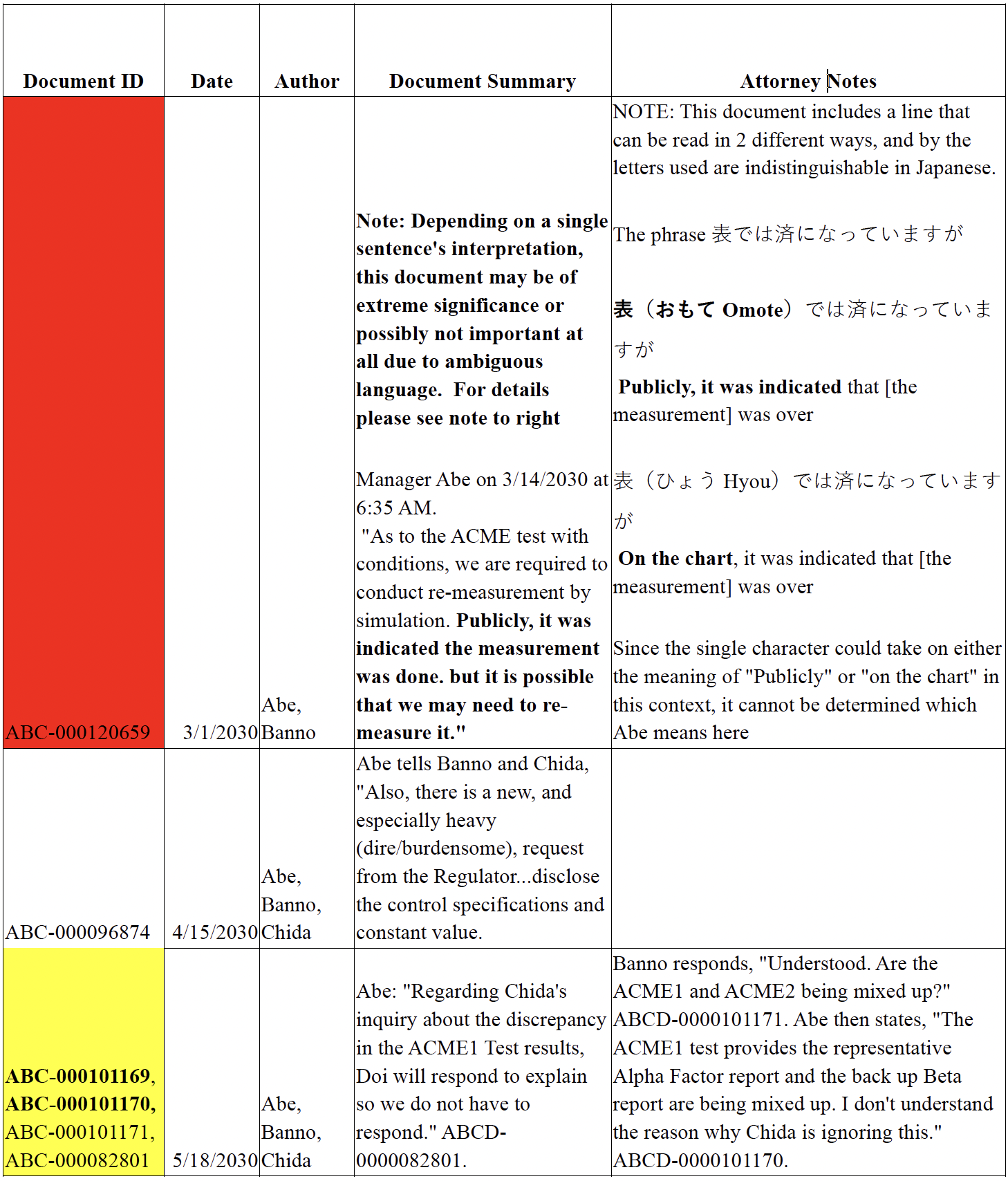
The sample below is an excerpt from a real Deposition Roadmap done by Hilgers Graben’s Japanese review team with the content modified to preserve client confidentiality. These are some selected descriptions of internal client discussions regarding component testing and regulators. The review team was tasked to search for any indication that testing results were not promptly being reported to regulators. In the top entry, we see that the meaning of a statement is unclear given that a particular Japanese Kanji character can be read two different ways.
Read one way, the character gives an implication that some testing results are being made public while others are not. Read another way, and the statement becomes relatively benign. In this case, not enough context was provided to discern which reading was correct, but it illustrates the importance of having a Japanese language professional review source material for evidence. Issues like this arise frequently while reviewing Japanese communications given the many language variables that effect the meaning of terms and passages.
Questions? Want to learn more? Contact us at foreignlanguage@hilgersgraben.com.
About the Authors
Remu Ogaki,
Counsel; Foreign Language Review Services
Remu has well over a decade of experience managing large teams of foreign language attorneys, paralegals and translators in the US and Japan. Follow him on LinkedIn here.

Glenn Yamada, Counsel; Foreign Language Review Services
Glenn Yamada is a seasoned e-discovery attorney at Hilgers, where he brings over a decade of expertise working in high-stakes, complex litigations. Follow him on LinkedIn here.